
Field notes
What is MCP, and how does your data flow through it?
The Model Context Protocol in plain terms: what it is, why it exists, and how one question makes a full round trip from your AI to your live data and back.
Your AI is smart, but on its own it is sealed off from your real stuff. It cannot see yesterday's sales or this week's ad spend unless something connects it to them. MCP is that something. It is a standard way to plug a real app or database into your AI and hand it a set of actions it can take.
MCP stands for Model Context Protocol. Think of it as a universal adapter. Before it, every AI tool needed its own custom wiring to reach Shopify or Slack or your database. MCP replaced that with one shared format, so any AI app that speaks MCP can talk to any tool that speaks MCP. Install once, and your AI gets a whole toolbox.
An MCP server is a toolbox
Each MCP server wraps one app or database and exposes a set of tools. A tool is one action your AI can take in that app: read recent orders, check stock, pull your return on ad spend. One server can expose dozens. Here are two I actually run.
The same idea wraps almost anything: Google Drive, Postgres, Slack, your own internal tools. You install a server once, and every tool inside it becomes something your AI can use.
How your data flows
When you ask a question, it makes a full round trip. Here is the whole thing on one page: your request runs left to right in coral, the data returns right to left in green, and the LLM does the analysis at the end.
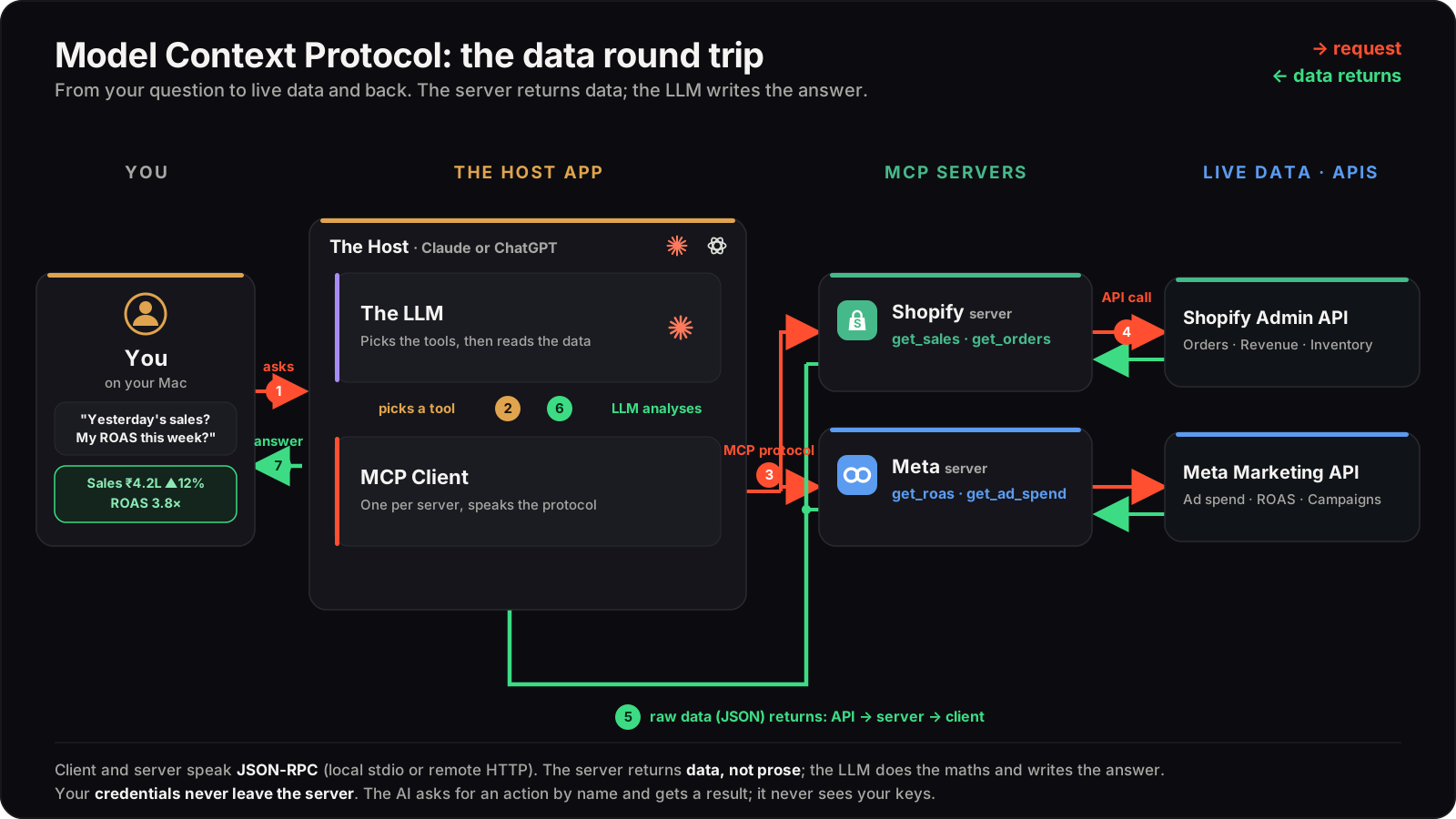
Prefer to see it move? The same diagram plays below, one step at a time.
Read in plain words, the trip goes like this. You ask. The LLM reads your question and decides which tools it needs. The MCP client calls those tools on the servers over the protocol. The servers hit the live Shopify and Meta APIs and pull raw data. That data flows back as JSON: API to server to client to the model. The LLM then does the actual analysis, computes your ROAS, and writes the plain answer you read. Seven steps, and it usually finishes in a couple of seconds.
What is actually moving between them
Three things are worth knowing once the shape clicks.
The client and server talk in JSON-RPC, either locally over stdio on your own machine or over HTTP to a remote server. It is a plain, structured way to say "call this tool with these inputs" and get a result back.
The server returns data, not prose. It hands back raw JSON, like a row of numbers. The language model is what reads that JSON, does the math, and turns it into a sentence. The server never writes the answer for you.
Your credentials stay put. The server holds the API keys and makes the call. The AI asks for an action by name and gets a result. It never sees your tokens, which is a big part of why this setup is safe to run against real accounts.
Why this caught on so fast
Before MCP, connecting an AI to your tools meant a pile of one-off integrations that broke whenever something changed. One shared protocol fixed that. Now your AI can reach Shopify, Meta, Google Drive, Postgres, or Slack through the same plug. You wire up a tool once and every future question can use it. That is the whole shift: from an AI that can only talk, to one that can go and do.